

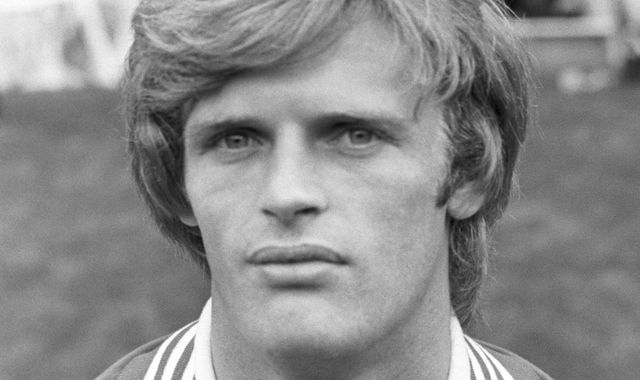
Heading a football is "likely" to have contributed to the brain injury which was a factor in the death of former Manchester United and Scotland defender Gordon McQueen, a coroner in North Yorkshire has found.
The central defender, who died at his home in North Yorkshire in 2023 aged 70, won 30 international caps between 1974 and 1981 and also played for Leeds United during a 16-year career.
Appearing at a hearing in Northallerton, North Yorkshire, earlier this month, TV presenter Hayley McQueen said her father had previously told his family that heading a football for so long "probably hasn't helped".
She said he was diagnosed with vascular dementia in 2021.
The cause of death was pneumonia as he had become frail and bed-bound for months, the inquest previously heard.
That frailty was due to a combination of vascular dementia and chronic traumatic encephalopathy (CTE), coroner Jon Heath said.
The coroner gave a narrative conclusion on Monday, finding that Mr McQueen died from pneumonia as a consequence of mixed vascular dementia and CTE - a brain disorder linked to repeated head impacts.
He said: "It is likely that repetitive head impacts sustained by heading the ball while playing football contributed to the CTE."
The inquest heard how Mr McQueen's family donated his brain, after his death, to Professor Willie Stewart - a consultant neuropathologist at the Queen Elizabeth University Hospital, Glasgow - who has conducted extensive research into brain injury in footballers and rugby players.
Prof Stewart told the inquest he found evidence of CTE and vascular dementia.
He agreed with barrister Michael Rawlinson KC, for the McQueen family, when he asked whether the CTE "more than minimally, negligibly or trivially" contributed to the death and that "heading the ball" contributed to the CTE.
The professor said the only evidence available was Mr McQueen's "high exposure" to heading a football.
After the hearing, the former player's daughter, Ms McQueen, said: "It should have been a turning point many, many years ago when we learnt the same thing with Jeff Astle and not much has happened between that time and now.
"Hopefully, my dad's legacy will not just be what he gave football on the pitch but what we can learn from this and make sure that this really real, horrible problem isn't a problem for future generations."
When giving evidence at the inquest earlier this month, Ms McQueen said her dad was relatively injury-free during his career but did suffer some concussions, adding: "They would just head back out and play."
She also recalled how, when she was young, he would come home from training with Manchester United and lie down in a darkened room with a headache.
Ms McQueen described how her father was very healthy and active - both in sport and with his family - during his playing days and after he retired.
But she said the family began to notice changes in his personality after his 60th birthday.
Ms McQueen said her father had always been very sociable and outgoing, but became more withdrawn.
Mr McQueen moved to Leeds from St Mirren in 1972, helping the Yorkshire club to league title success in 1973-74 and playing a key role in their run to the European Cup final in 1975.
He then joined Manchester United in 1978 and went on to win the FA Cup in 1983. He also scored in the 1979 cup final defeat to Arsenal.
Read more from Sky News:
Amber 'danger to life' warnings as storm approaches UK
Schools should be 'phone-free' all day, teachers told
Calls to ban heading in the game
Five of England's 1966 World Cup-winning team - Sir Bobby Charlton, his brother Jack Charlton, Ray Wilson, Martin Peters and Nobby Stiles were diagnosed with the disease, which either caused or contributed to their deaths.
Former England and West Brom striker Jeff Astle died at 59 in 2002 because of repeated trauma from heading footballs, described by a coroner as an "industrial injury".
Growing evidence that heading the ball can cause brain damage has led to calls for a ban, with scientists also warning of the risks.
The game's European governing body, UEFA, said in 2020 young footballers should be doing less heading of the ball.
It was prohibited in English football for matches involving under-7s to under-9s during the 2024-25 season.
The ban was expanded to under-10 matches this season and is projected to cover under-11 games from 2026-27.

(c) Sky News 2026: Heading football 'likely' to have contributed to death of former Man Utd star, coroner finds
 Storm Chandra forecast to bring snow, strong winds and heavy rain to UK
 Remains of last Israeli hostage found in Gaza
 Xi's purge of top general paints a fascinating picture of power and control within a ruthless and unforgiving system
 More than 500 report sexual abuse during military medical examinations
 Facial recognition technology to be rolled out nationally and police will get AI support